The GardenDespatches from The Satyrs’ Forest

Posts tagged as “Newcastle”

Why is the Metro shaped like a pretzel?

The Tyne and Wear Metro is a marvel of the British railway network: the only true metro system outside of London and Glasgow1, with fully accessible stations, beautiful typographic design, and only the occasional closure because someone stole all the copper wiring again. But amongst railway nerds, it is also known for one more puzzling detail: it’s a pretzel.
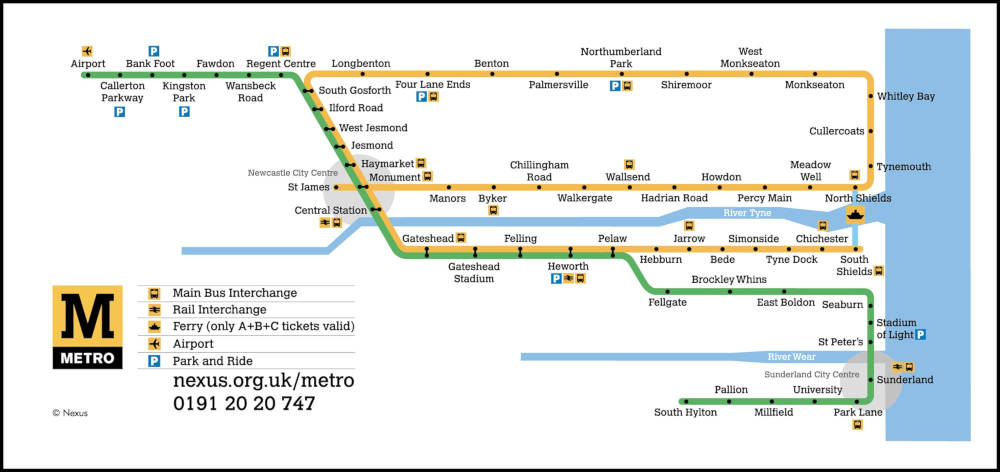
A map of the system, showing two lines — green and yellow — the latter of which goes around in a loop and intersects with itself
Š Nexus

That’s right: you can, if you want, catch a Yellow Line train at Monument, go all the way around the coast, wind up right back where you started, and continue all the way down to South Shields just to rub it in. Put otherwise: there are four platforms and they’re all for the same line.

This is, as far as i know, unique to Newcastle. Bucharest almost gets there, but chickens out just before the line actually crosses over. Sofia nearly pulls it off but, in a shocking display of cowardice, redesignates its Line 4 as “Line 2” halfway through the loop, disqualifying them immediately. The Hague does something even more complicated, but it’s on a tramway and i can’t in good faith count it. And Vancouver used to have the same setup — even using the same colour — but switched to a perhaps more sensible timetabling in 2016 when an extension rendered it unworkable.

So… why? What’s the point? Let’s find out.

Part One: Why was it a pretzel?

As is often the case with urban rail, the constituent parts of the Tyne and Wear Metro were built at different times by different, competing companies, and were only later stitched together into a coherent network.

The first part of the loop to come online was the Newcastle and North Shields Railway, starting in 1839, who ran a service from the centre of town to (where else?) North Shields, later extended a teensy bit further to Tynemouth. The N&NSR’s mighty viaducts still carry our dinky yellow trains over the Ouseburn to this day.

Meanwhile, further north, coal mining in Northumberland was growing rapidly. (This brought great prosperity to the region, which would surely never ever end. Ever. Unless they closed the mines, but come on, why would that ever happen?) The existing main-lines found themselves choked by the influx of traffic, and in 1852, Parliament authorised the incorporation of the newfangled Blyth and Tyne Railway.
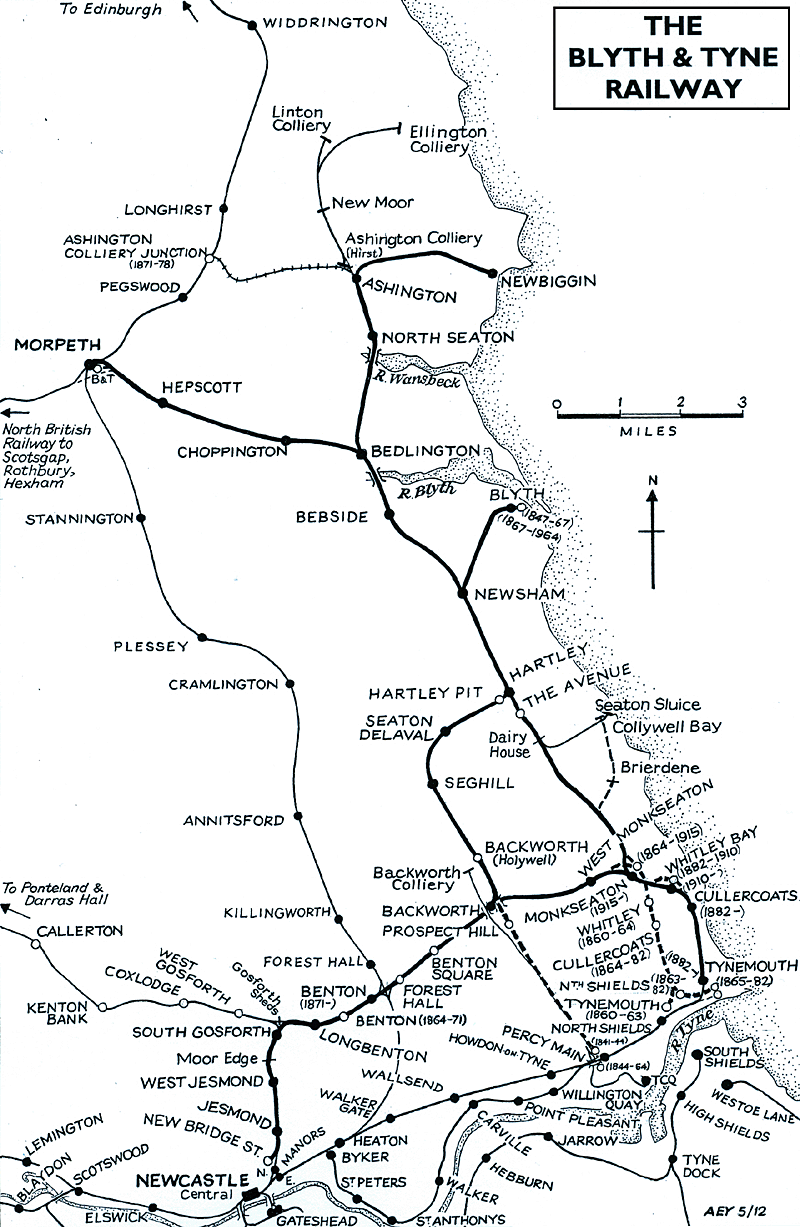
A map of the Blyth and Tyne network, showing it tracing the northern half of today’s Metro loop
Courtesy of the excellent Disused Stations website.

The B&T at first linked Bedlington and Blyth only to the staiths at Percy Main, but by the eighteen-sixties it had added branches to the centre of town — encouraging buildup in Newcastle’s northern suburbs — and to the growing seaside holiday destination of… Tynemouth.

Hm.
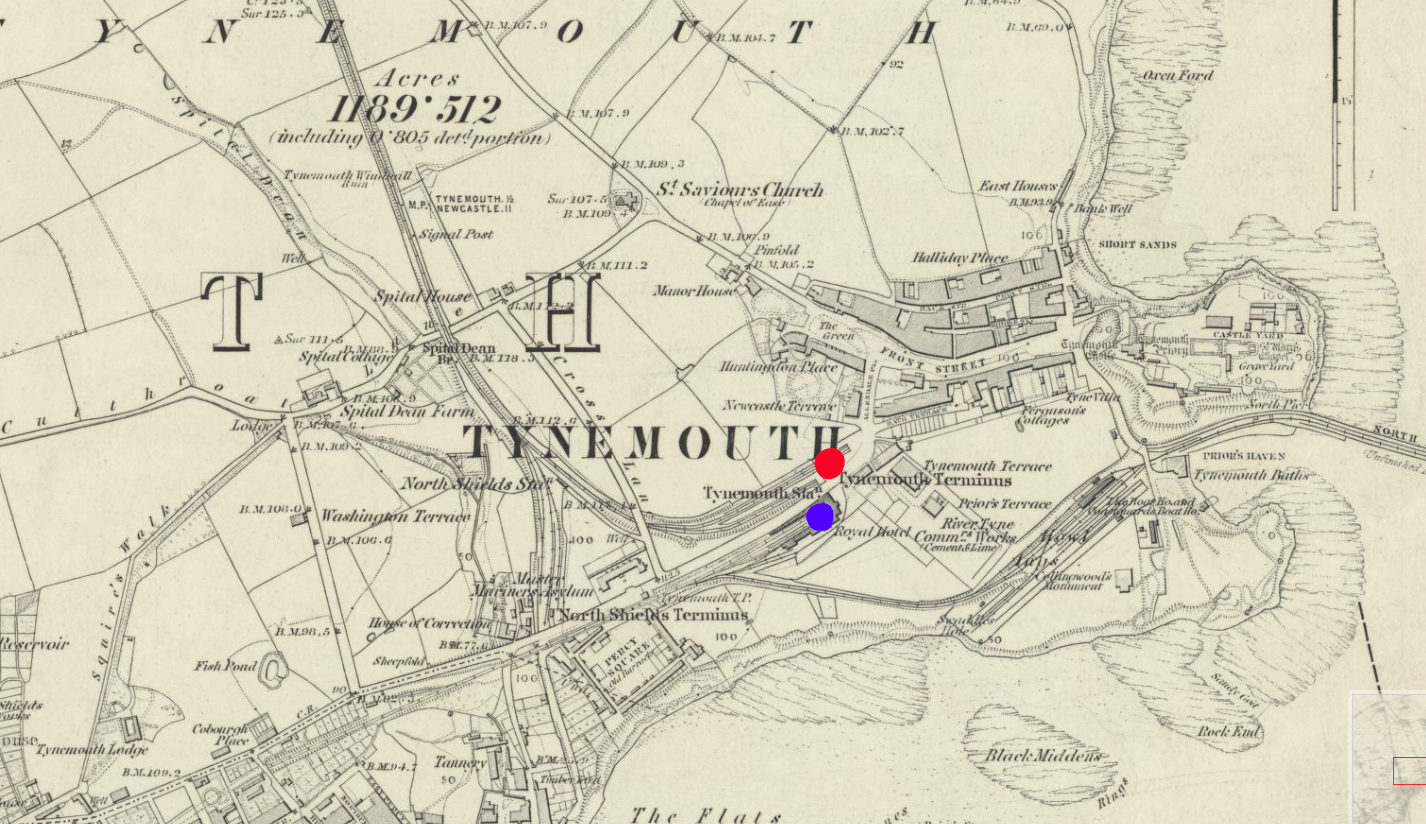
An old Ordnance Survey map showing the two lines at Tynemouth meeting, but not being able to transfer onto each other
Red is the Blyth and Tyne’s station; blue is the Newcastle and North Shields Railway’s.

By the early eighteen-eighties, both the B&T and the N&NSR had been absorbed into the North Eastern Railway, which found itself in the awkward position of having two formerly competing stations right next to each other and no way for trains to transfer between the two. So, in 1882, the two competitors’ lines were linked up with a new alignment running closer to the coast, including the opening of a gorgeous palatial through station at Tynemouth, still in use by Metro trains and Sunday markets to this day.
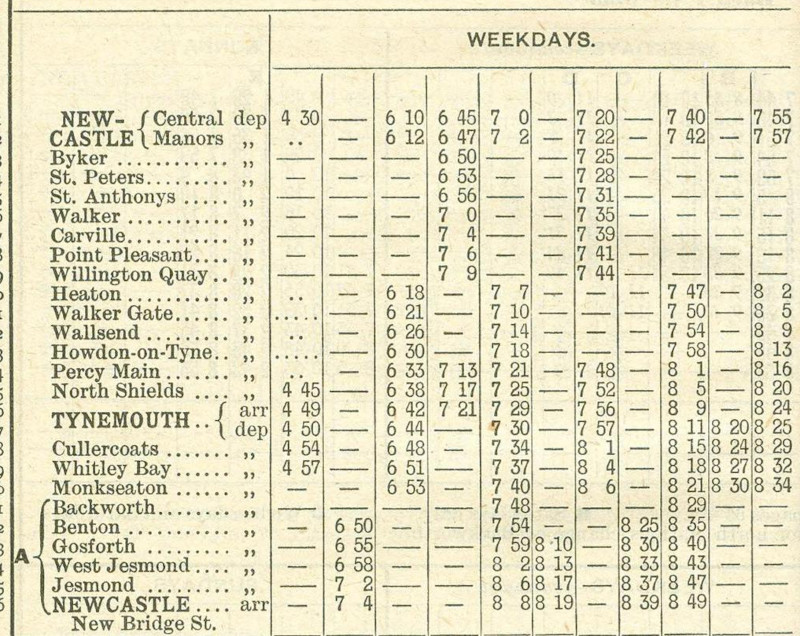
A timetable showing the following stations in order: Newcastle Central, Manors, Byker, St Peters, St Anthonys, Walker, Carville, Point Pleasant, Willington Quay, Heaton, Walker Gate, Wallsend, Howdon-on-Tyne, Percy Main, North Shields, Tynemouth, Cullercoats, Whitley Bay, Monkseaton, Backworth, Benton, Gosforth, West Jesmond, Jesmond, Newcastle New Bridge St.
Hang on — “New Bridge St.”? A story for another time.

The earliest timetable i could find, from 1902, shows that trains were indeed running in a loop around the coast, from the city centre to Wallsend to Tynemouth and back, just as is possible today.
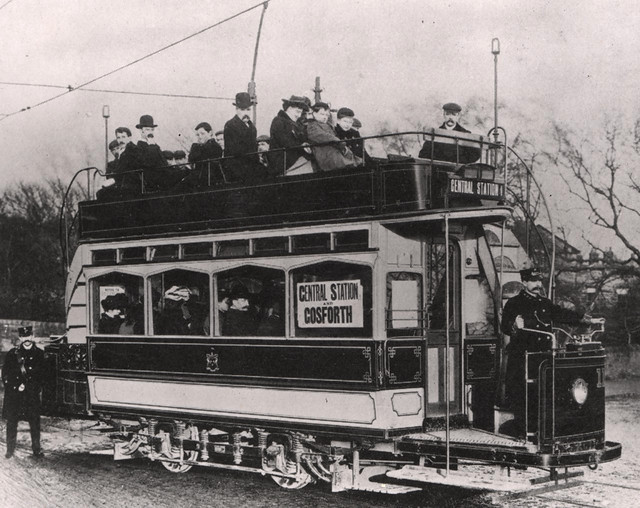
An old-timey electric tram on its way to Gosforth
Courtesy of the always-excellent Co-Curate

At the dawn of the twentieth century, however, the steam services were threatened by a rising competitor: the tram. No longer did you have to put up with noisy, steam-belching locomotives every day — you could get to exactly where you wanted to go, in style! This, of course, wouldn’t do, and so the NER embarked on a rapid programme of electrification. By 1904, the loop had fully switched over, and the network was rechristened the ✨️ Tyneside Electrics! ✨️
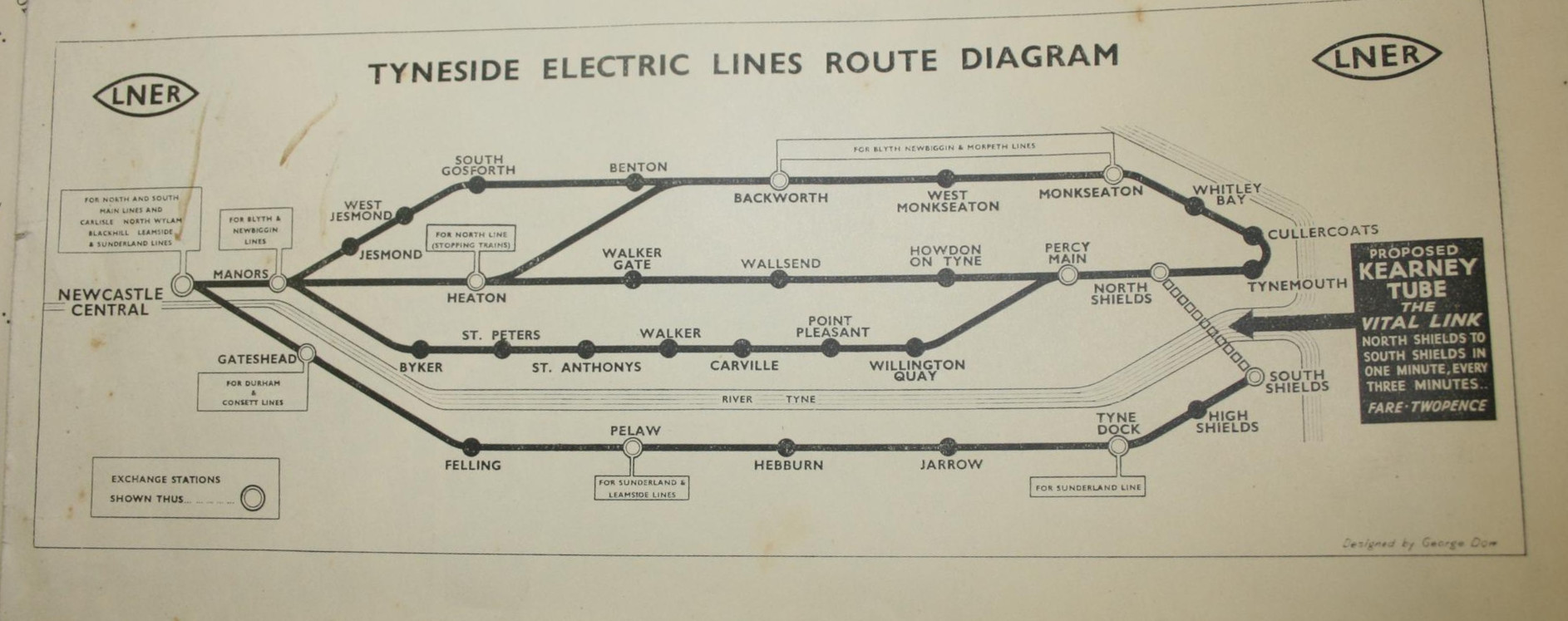
By this point, the network clearly resembled what we have today. Now, it didn’t quite loop over itself like today — everything went through Central Station; no perpendicular Monument tomfoolery here — and there was an extra branch snaking along the riverside which was never refurbished for the Metro era. But other than that, the geometry was pretty well set, and there would be no major service changes until the introduction of — what do you mean, you want to know what the big black arrow’s for?

Part 1½: The Kearney Tube

Whenever i show a diagram of the Metro to my non-Geordie friends, the first response is usually something to the effect of, “Why isn’t there a link between North and South Shields?” It’s a fair question, and the canned answer i usually give is that building one would be a lot of expense for little point, since there’s already a well-trafficked, well-loved ferry service between the two. Little did i know that it could well have been otherwise.

Elfric Wells Chalmers Kearney was an eccentric Australian engineer who spent much of his life trying and failing to convince city governments to adopt his all-new danglebahn, the Kearney High-speed Tube™. Here he is in 1910 with a model he made earlier:
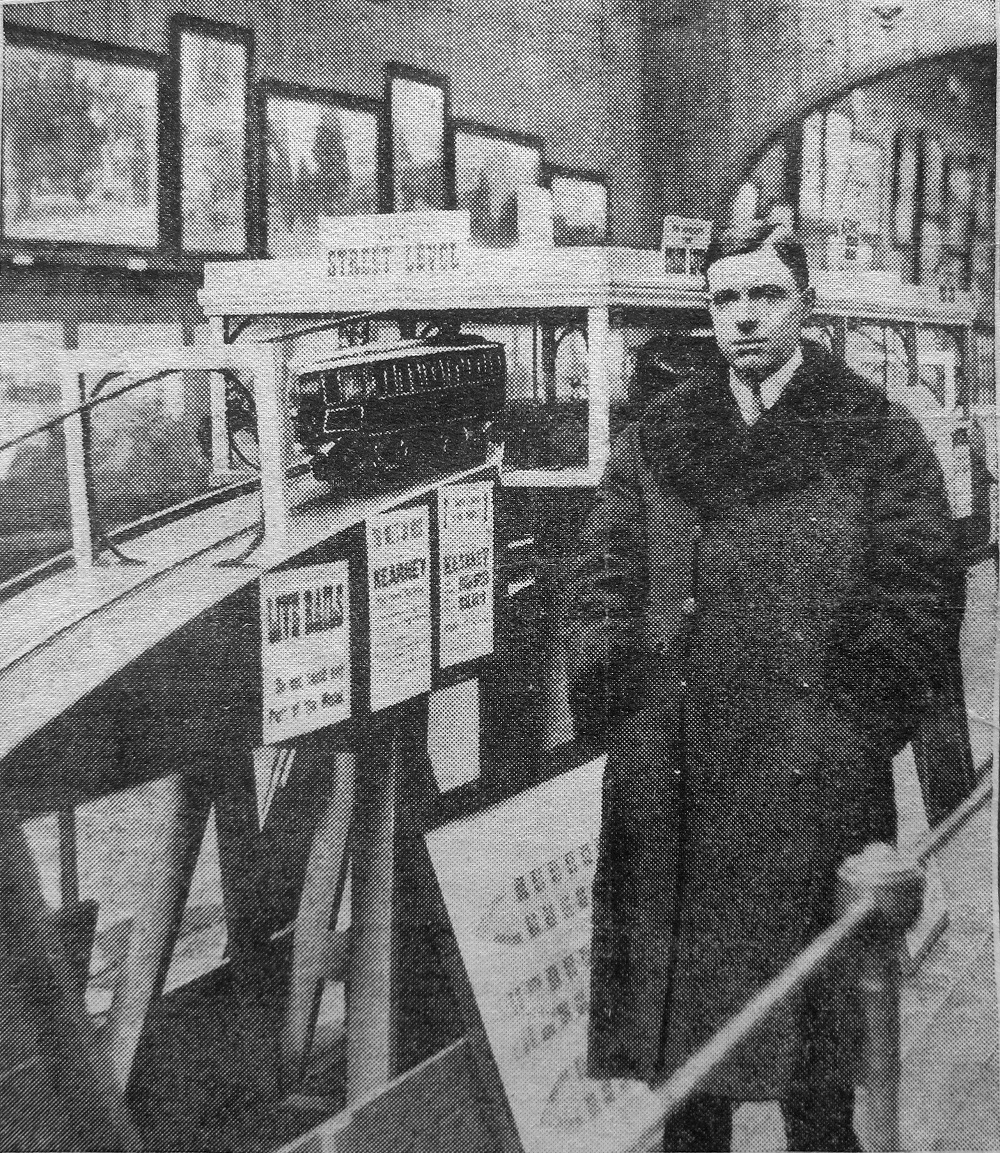
An Edwardian gentleman in a dark coat stands next to a scale model of a railway descending down a steep gradient
Do you think they ever gave him his Blue Peter badge? (Photo courtesy of Recondite Harmony)

The “Kearney Tube”, as it was known, would be powered by the force of gravity, hurtling down a ⅐ gradient from stations just below the surface like a bizarro funicular before climbing gracefully back up, suspended between a monorail below and a guide rail above, which would (in theory) stabilise the train’s side-to-side motion so as to not induce vomiting in everyone who rode it.

Mr Kearney promoted his invention in cities as distant as Sydney, London, Portsmouth, and (if secondary sources are to be believed) Venice and New York, but it came closest to reality between North and South Shields.

Over sixteen thousand Tynemouthicans signed a petition calling for its construction, and in 1925 the government gave a provisional order approving its construction. Alas, when it came time for a parliamentary committee to give Mr Kearney’s dream the final go-ahead, they were rather more sceptical. He had raised nowhere near enough money to actually build the blasted thing, and the members were quite concerned about the impact it might have on the livelihood of the Tyne’s ferrymen.2

Mr Kearney held a grudge for the rest of his life. He made elaborate, typewritten conspiracy diagrams indicating who was paying off who, and gleefully wrote of the death of his opponents on the committee — or even those who were only tangentially connected:

Under pressure from Lord Ashfield, Henry Ford went back on his undertaking to finance the first Kearney Tube between North and South Shields. Not long afterwards Esdell Ford [sic], Henry Ford’s only son, was taken ill and died.

In 1939, he gave it one more go, partnering with the LNER — only for the outbreak of the second world war to put an abrupt halt to any civilian infrastructure plans. He would eventually write a science-fiction novel titled Erōne, where his his protagonist’s ideas are proven correct by a utopian society on Uranus, and if only the good people of Earth would listen!

Mr Kearney died in 1966, never having seen his utopia come to fruition. I was unable to find where or how, or even in which continent he is buried — he split his time between Australia and Britain, and he could plausibly have passed on either side of the equator. Still, i hope he’s up there somewhere, smiling down on all the shweebs, hyperloops, monorails, and other gadgetbahns of today.3

Part Two: Why is it a pretzel?

By the nineteen-sixties, the Tyneside Electrics had seen better days. Passenger numbers were falling, the trains of tomorrow were decrepit, and they weren’t even electric — British Rail had deemed it more cost-effective to run slower, dirtier diesel trains. The system had become a kittiwake4 around the North East’s neck. So, in 1971, the local transport executive commissioned a study — and they came back with a plan.

You know how the rest goes. Though the Tyne and Wear Metro would mostly reuse the existing routes mentioned before, they would all be linked up through a newly constructed central core underground — meeting in the middle at Grey’s Monument.
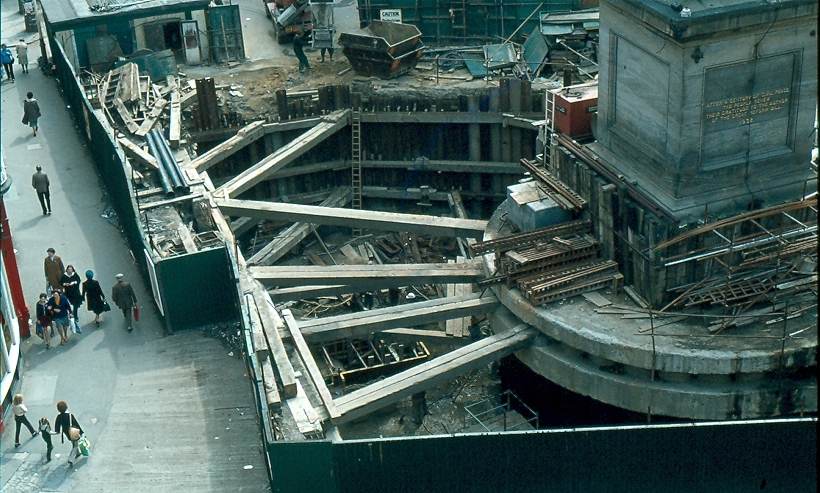
Construction of the station at Grey’s Monument, showing a deep underground trench dug around it
Courtesy of… the Metro’s official Facebook page? Sure, why not.
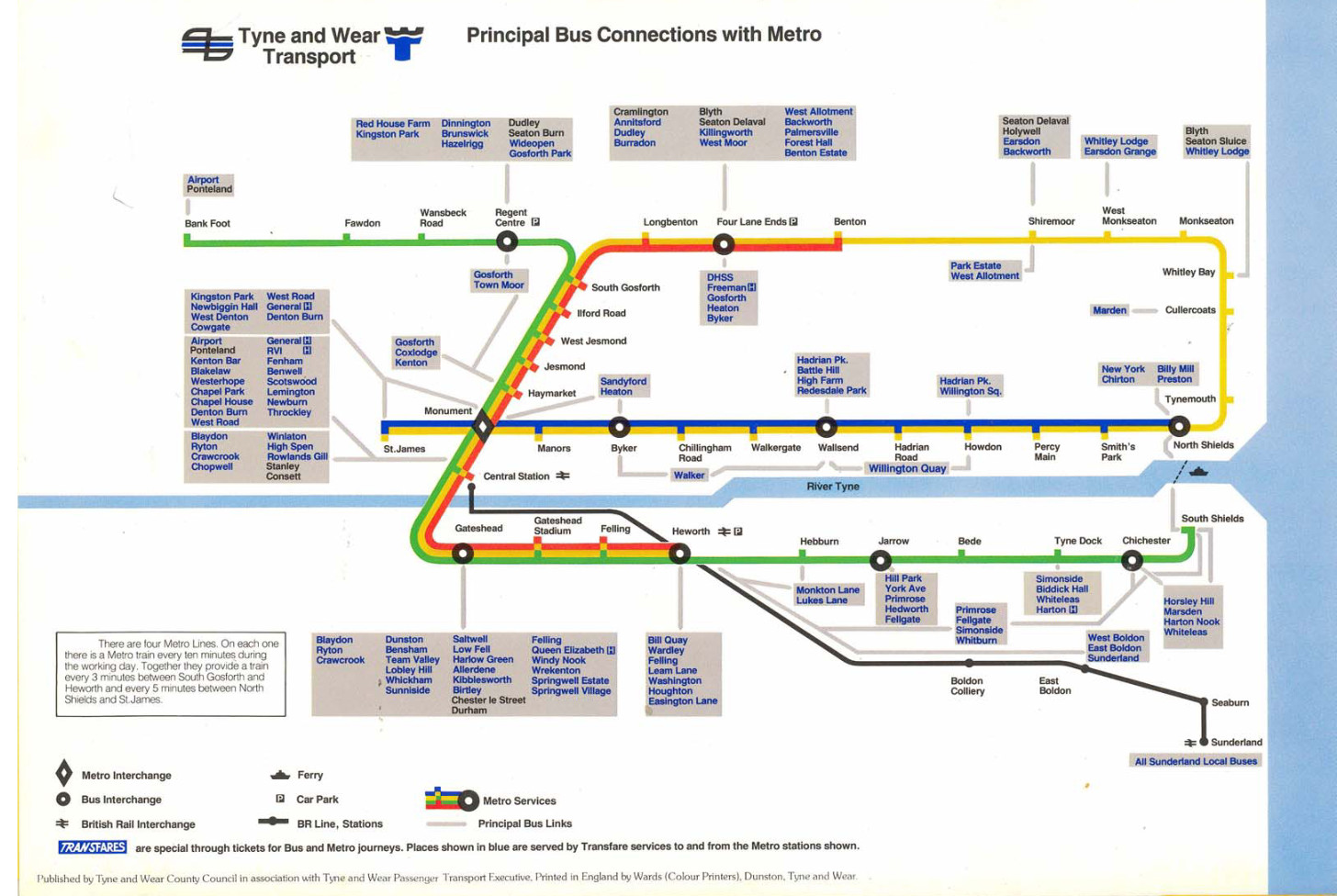
A map of the Metro as it was in the eighties, mostly the same as today but with a few “express” lines and without the branch south to Sunderland
A map of the system upon its completion in 1984, taken from this contemporary pamphlet, whose graphic design you simply must check out.

The pretzel shape was completed by proceeding one stop further from Monument to stubby St James’ Park.5 This was just a temporary terminus, of course — the station was built so that, in future, they could easily come back and extend it out to the long-underserved west end of the city. Quoth 1981’s “Tyne and Wear Metro: concept, organization, and operation”:

St James station is at the centre of an area designated for future office development and also serves the football ground; the station has also been designed to allow the system to be extended westwards at some future date.

So, eventually, that happened, right? They turned that little stumpy arm into a full-fledged extension. Right? …Right?

Part Three: Why is it still a pretzel?

In 1981, environment secretary Michael Heseltine vetoed any further extensions to the Metro system. Since then, the only substantive changes have been in 1991 — inking the airport to the rest of Newcastle — and 2002, when, after twenty years, the Tyne and Wear Metro finally reached Wearside. It is around 2002 that things get a little silly.
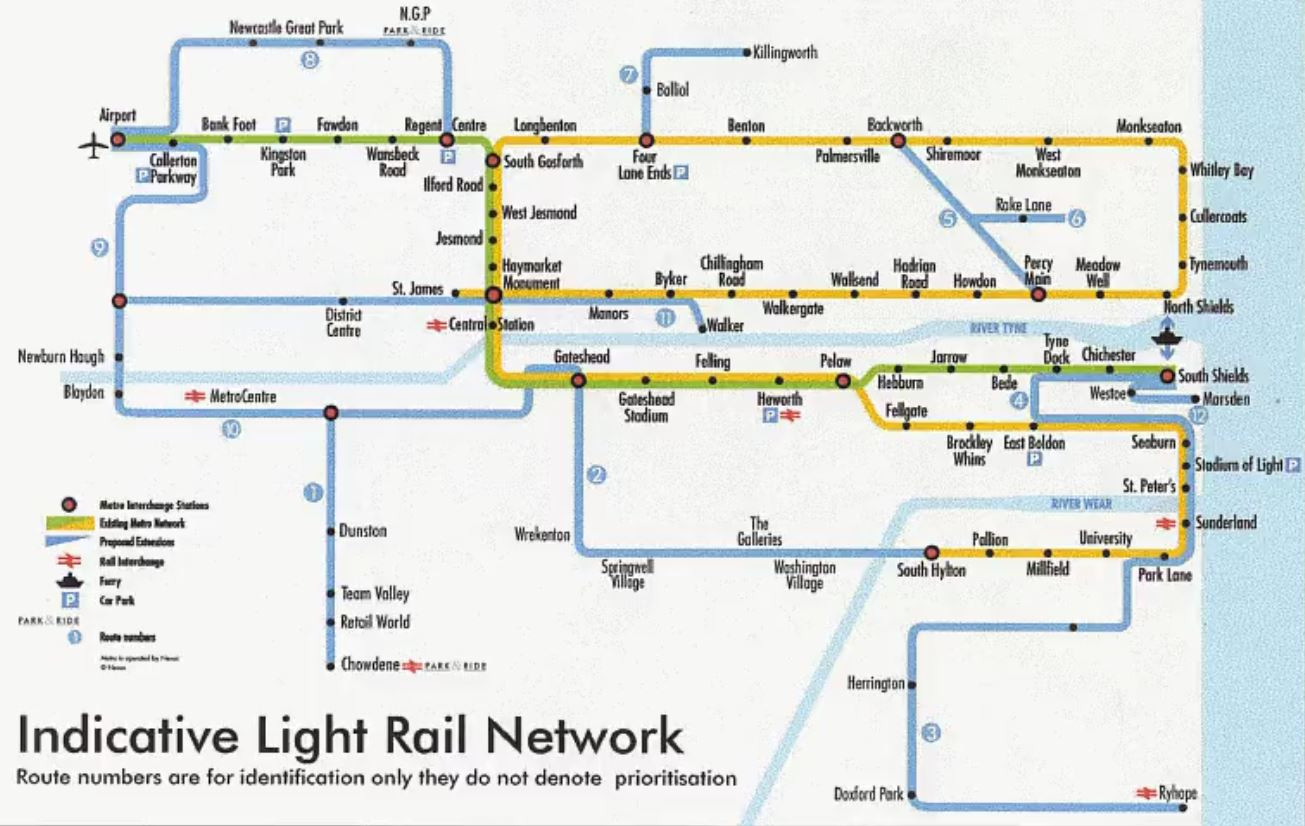
A map of various proposed extensions to the metro network
This map floats around the internet a lot, though i haven’t been able to tie it back to its original source.
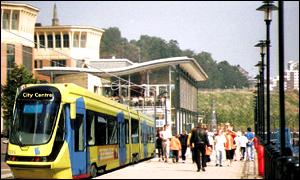
A mockup of a tram running across a Newcastle street
Via the linked BBC article.

Shortly after service to Sunderland began, Nexus (the local transport operator) announced Project Orpheus, their grandiose plan to build a transport network fit for the twenty-first century. Bus rapid transit for everyone! A cable car in Gateshead! And, yes, the valiant return of trams to Newcastle-upon-Tyne, connecting the west end up with the city centre.

None of this happened. The plans were watered down and watered down until all that was left was the vague idea of refurbishing the Metro and making buses more frequent. The great recession and austerity presumably killed any hope it had left. You still get calls from local councillors to extend the system to their part of the area, but they seem unlikely to amount to much. So is all hope lost?

Well… remember the Blyth and Tyne Railway?
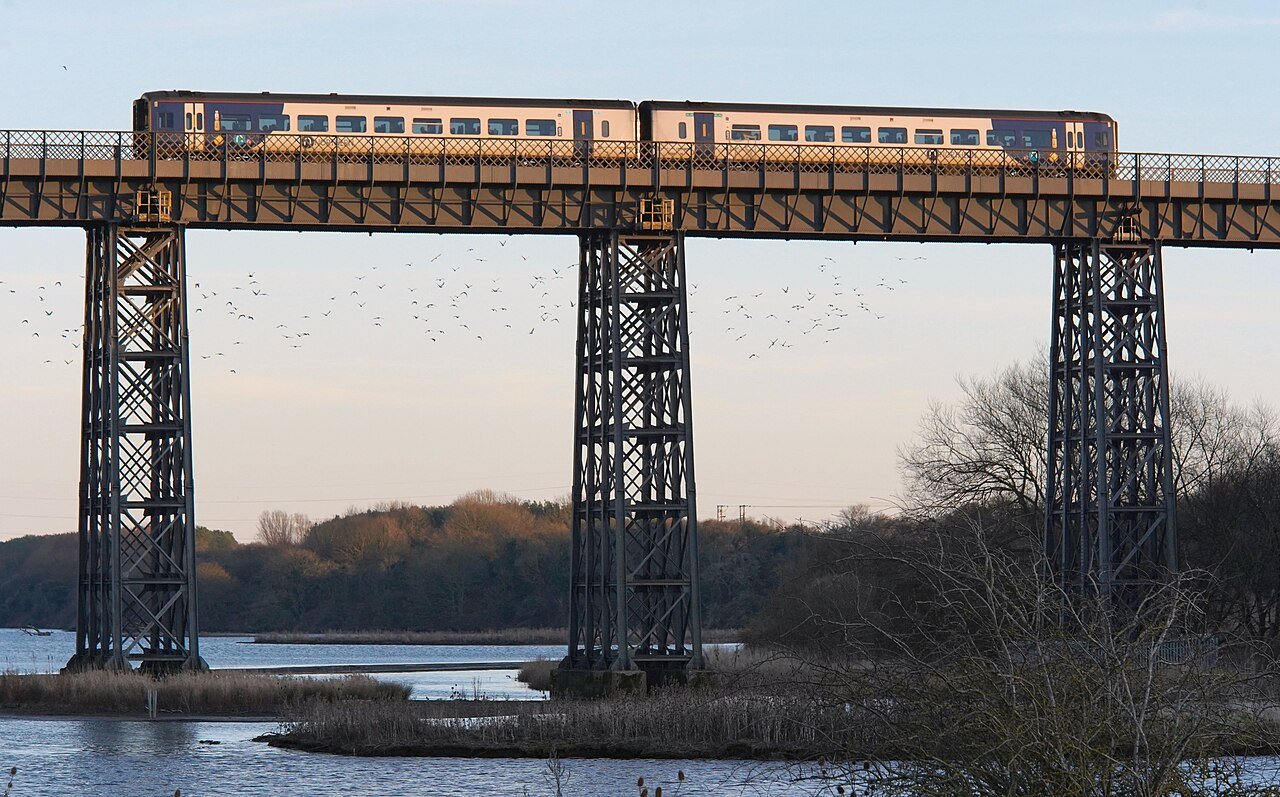
A Northern train crosses a viaduct over the Wansbeck river
A Class 158 crossing the Wansbeck Viaduct. CC-BY, courtesy of Steve Knight.

Passenger services along the B&T north of Backworth were given the chop by Dr Beeching in the nineteen-sixties. Combined with the end of coal, this was a one-two punch in the gut for working-class mining towns like Ashington and Blyth, leaving them some of the most impoverished in the country.

Local campaigners have been calling for its reopening since the nineties, initially to little avail barring a token mention in the ill-fated Project Orpheus plan. In 2013, Northumberland County Council started taking the idea seriously. In 2019, the transport secretary gave the thumbs up. In 2021, shovels hit the dirt. And in 2024, for the first time in half a century, trains carried passengers from Ashington to Newcastle.

It may be like pulling teeth, and it may cost more than we might like, but Britain can still build things — and local politicians seem to have noticed! In 2024, work began on the first serious proposal since Orpheus to extend the Metro; this time, to Washington, along the disused Leamside line.
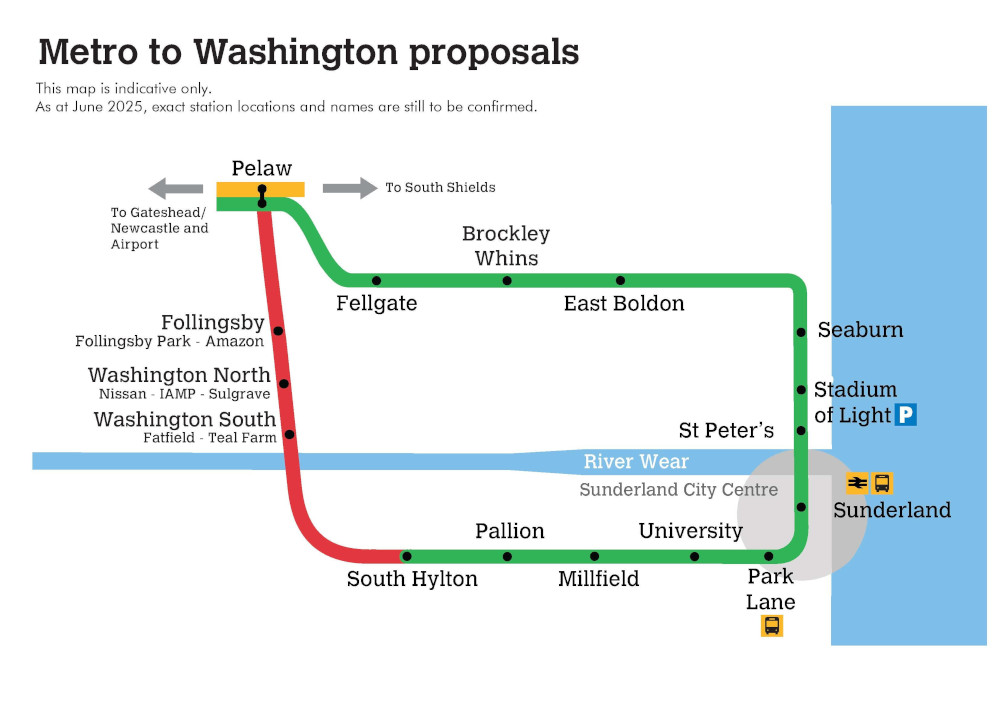
A diagram of the proposed extension to Washington, showing the Green Line going in a loop
Š Nexus

Curiously, the proposed extension goes in yet another loop. It’s hard to imagine this wouldn’t require some rejigging of how the network runs — a third line, perhaps? New platforms at Pelaw? But however they run it, it looks like, if it goes through — and that’s a big if — the Yellow Line may not be alone in its topological weirdness for long.

A walk down to the Quayside

https://www.youtube.com/watch?v=w1eN8vyVFIM
This article comes equipped with its own optional soundtrack for those who want to follow along with my listening habits as well as my walk.
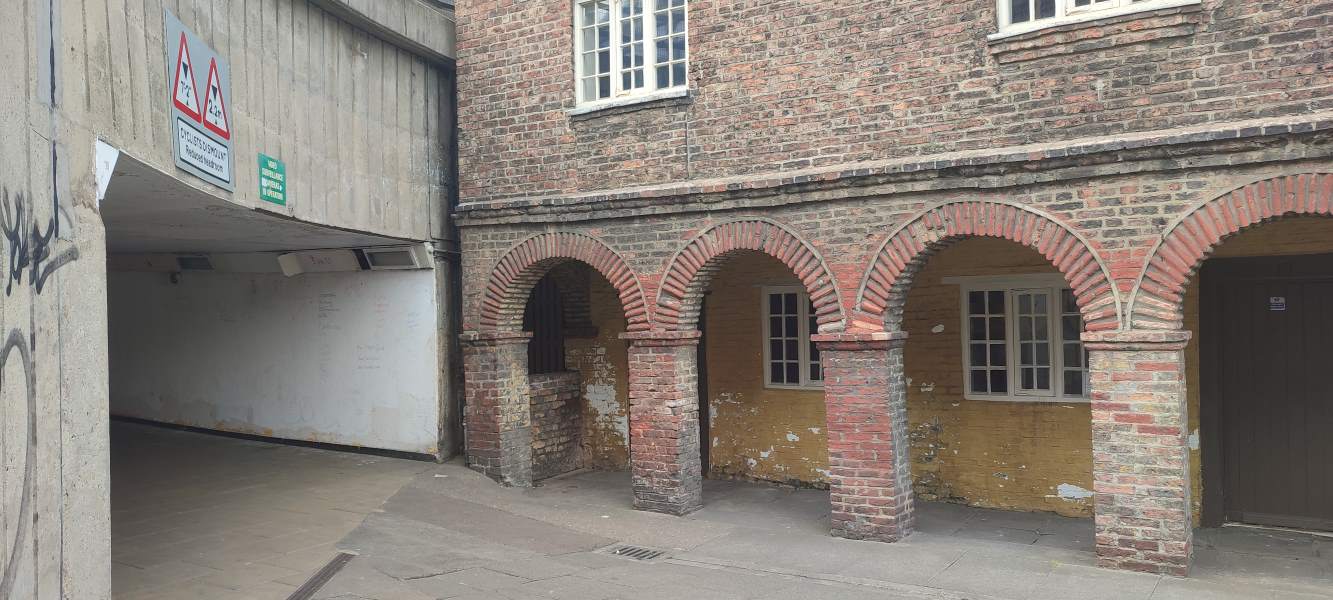
A decaying building’s brick-arched frontage contrasts with a concrete underpass.
We begin at the Holy Jesus Hospital, whose site served as an almshouse for the poor for seven hundred years.
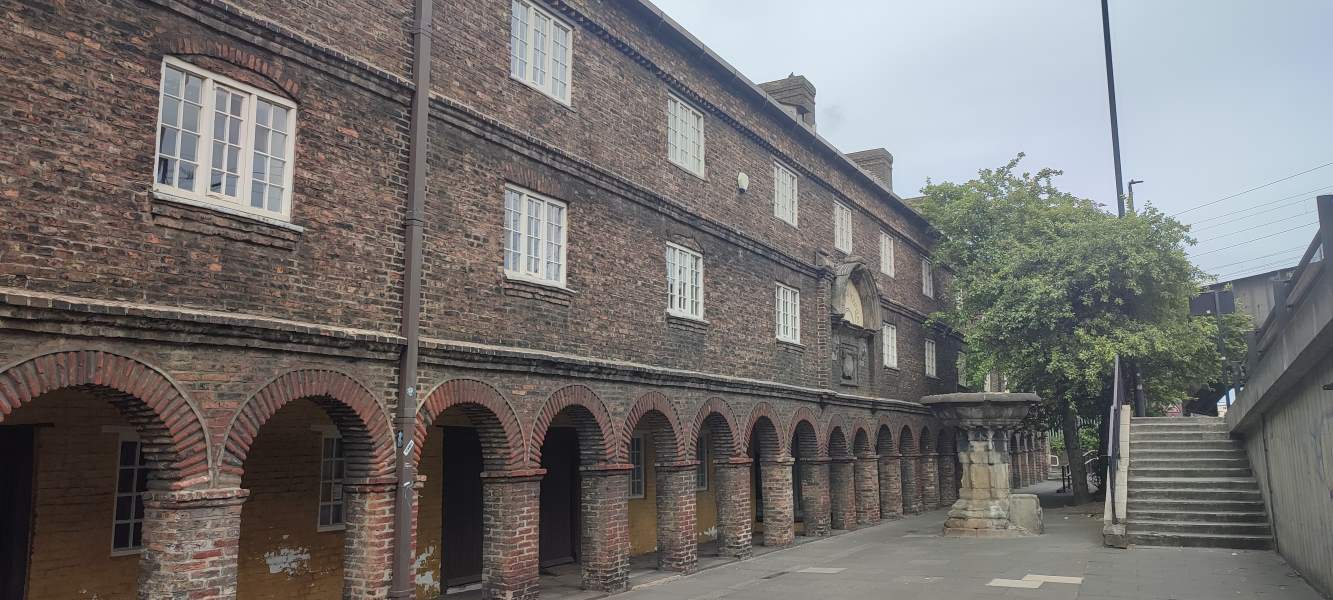
More brick arches, trailing off into the background.
The current 17th-century building now serves as office space for the National Trust. No noseys allowed (shame!)
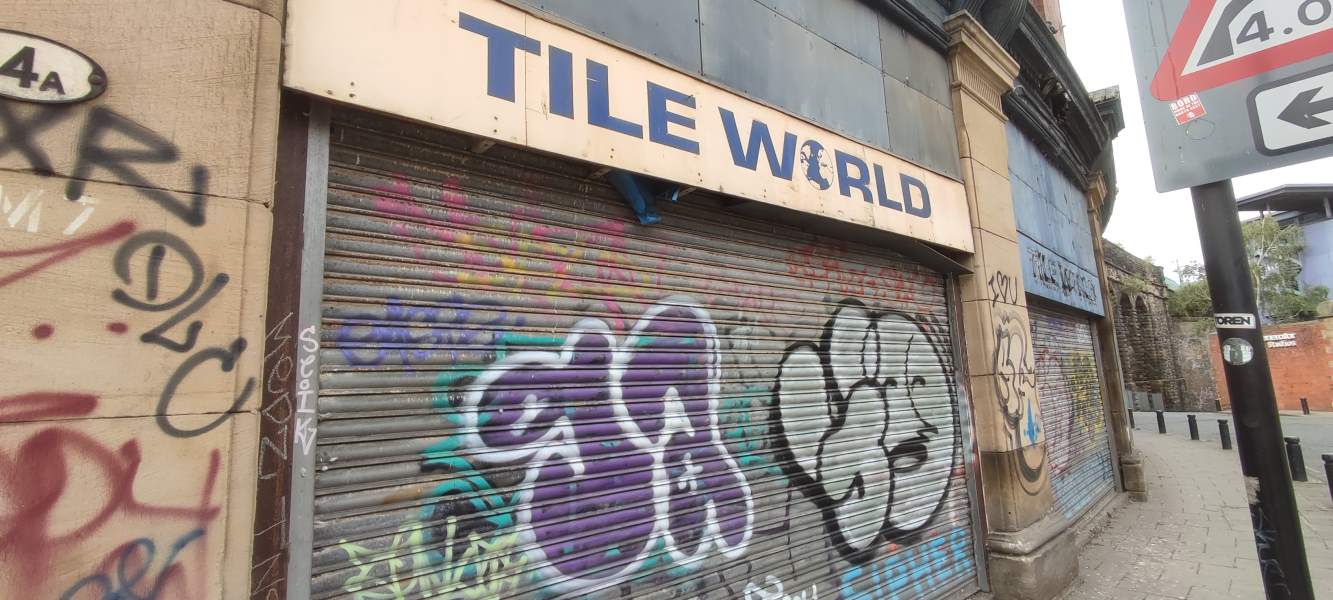
The frontage of a shop by the name of “Tile World” (with a globe replacing the O), its shutters now covered with graffiti.
Anyone need some tiles?
I’m pretty sure this is either “Hallelujah” or “Jerusalem”, but i have absolutely no idea which.
https://www.youtube.com/watch?v=FQlAEiCb8m0
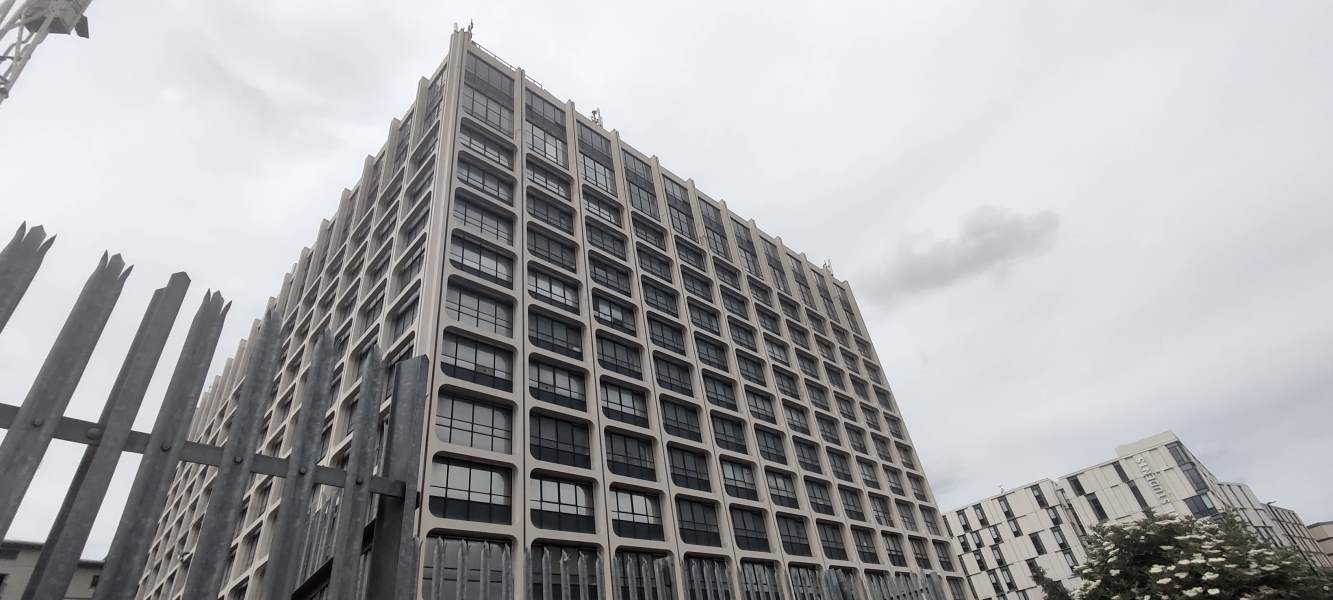
A hulking grey concrete building scrapes the sky.
Only a scant few BT-branded trucks occupy the parking lot of this hulking concrete husk, surely far too big for its intended purpose.
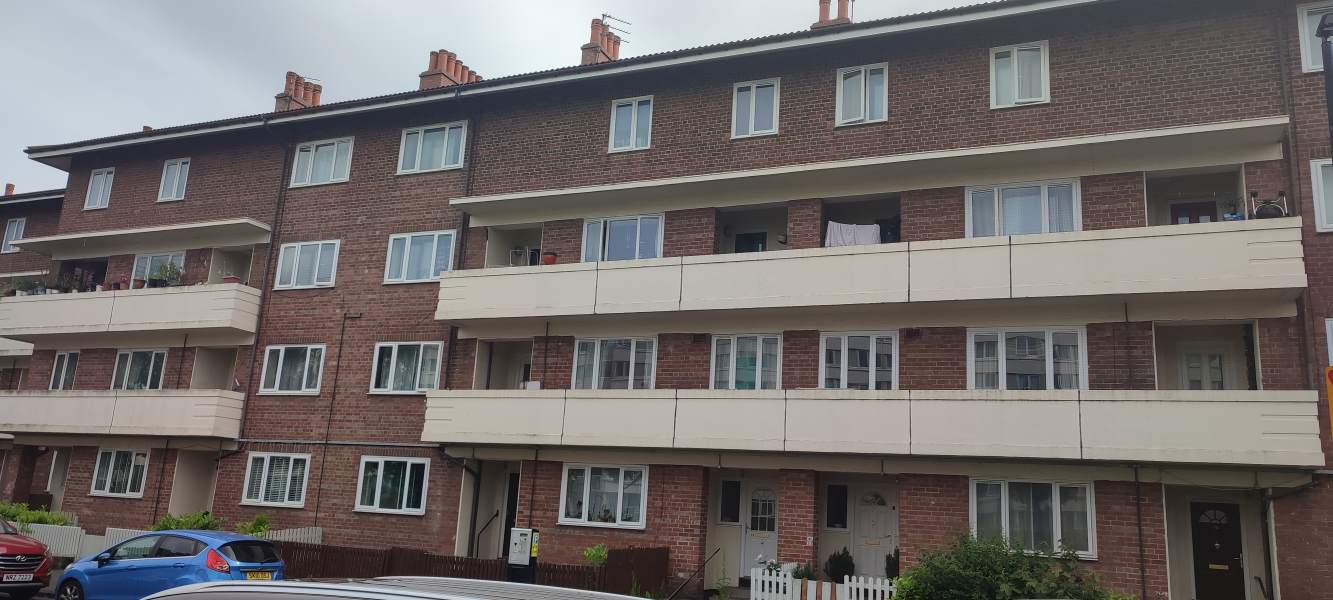
Four floors of brick flats.
Ahhh — reminds me of home, back in Hoorn.
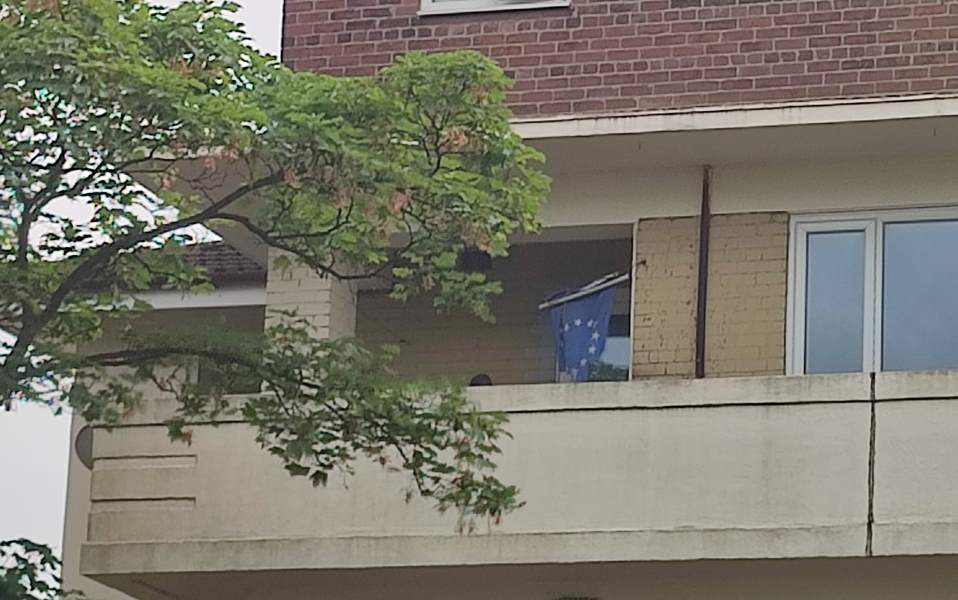
A worn European Union flag hangs over a balcony.
The tragedy of Brexit.
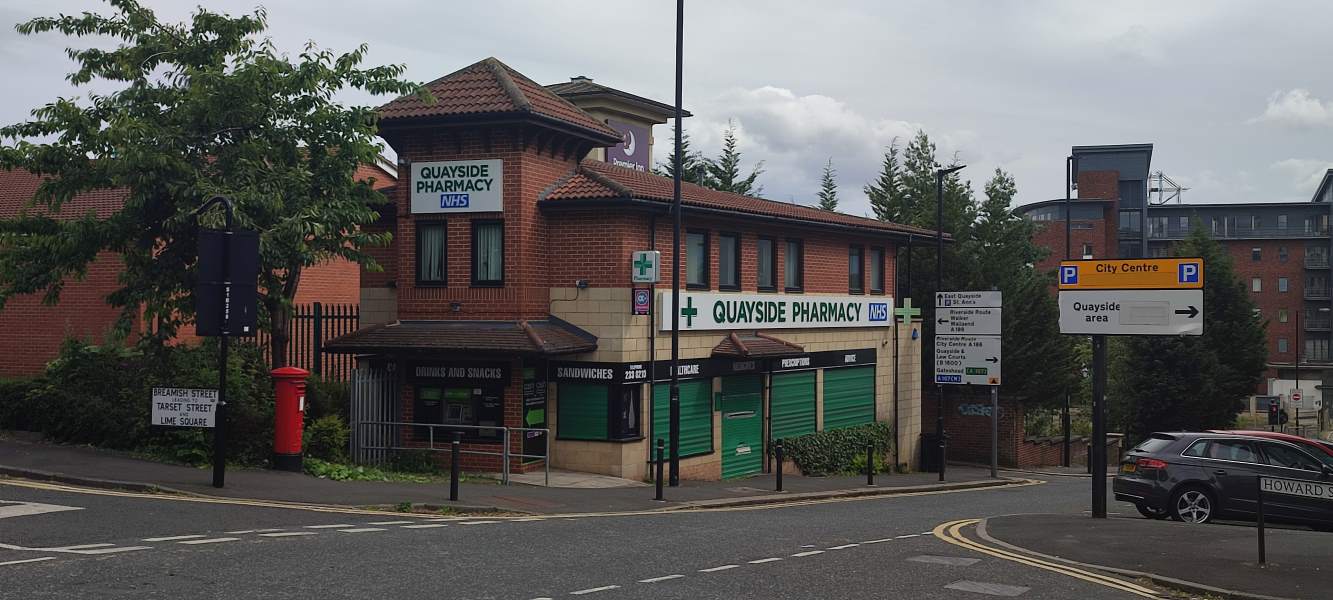
Quayside Pharmacy
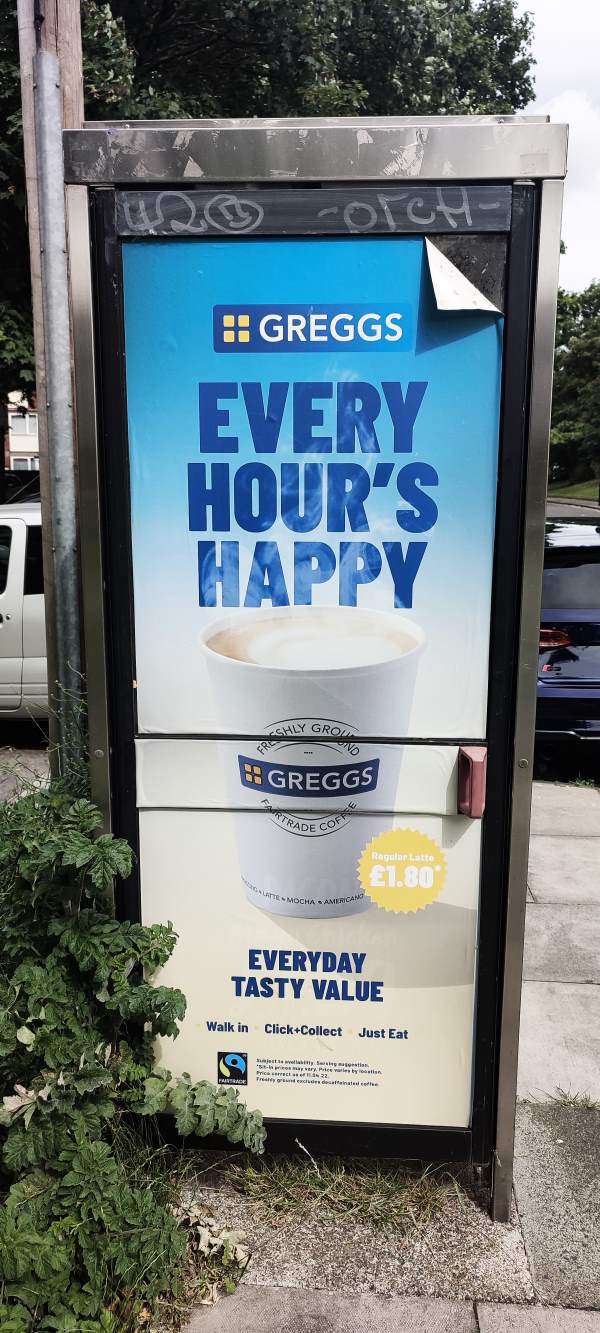
An advert for Greggs’ all-day coffee, reading “Every Hour’s Happy”.
Is it, Greggs? Is it?
https://www.youtube.com/watch?v=1hHSH9sJUEo
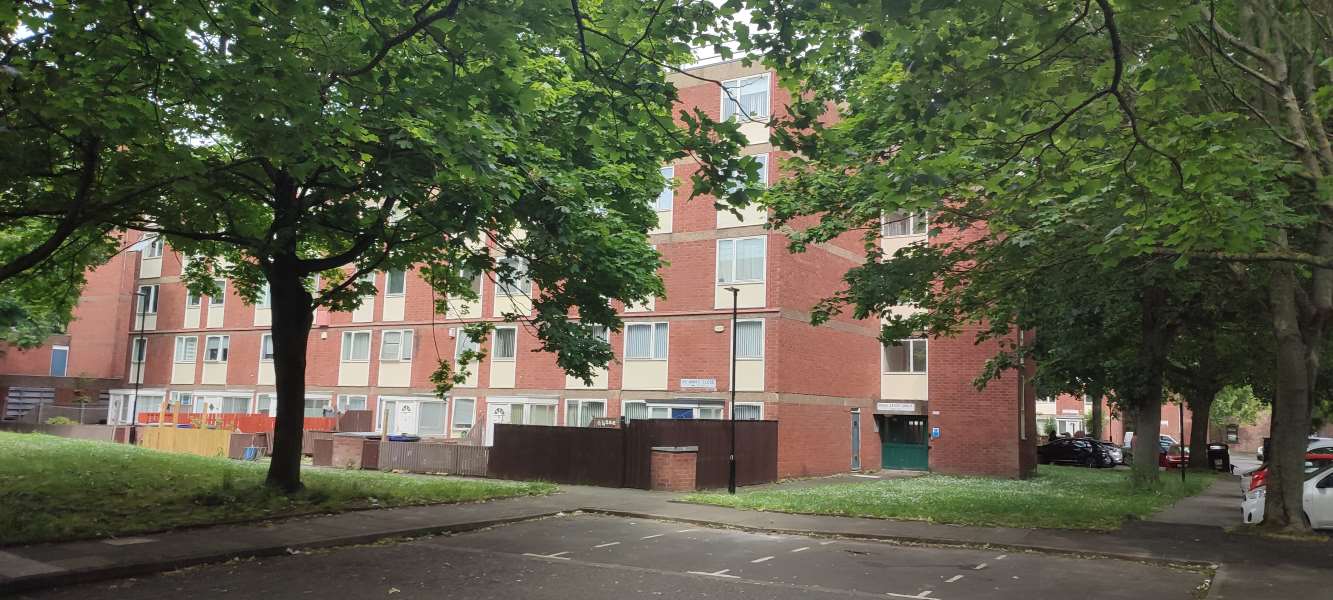
Leafy trees and paths cover another brick flat.
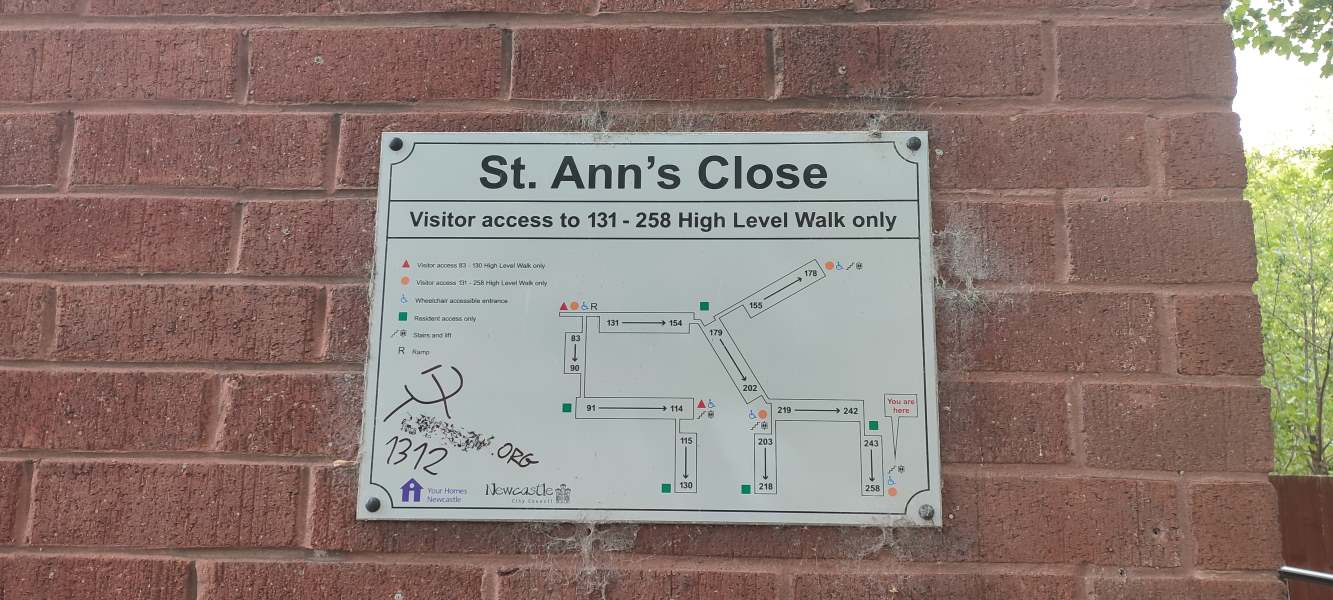
A diagram of the flat of St Ann’s Close has been vandalised with a hammer and sickle, a blurred-out website link, and “1312”.
There’s a lot of commie graffiti scattered along this road, though all of it seems to be by the same person — you can tell because they can’t draw a hammer and sickle.
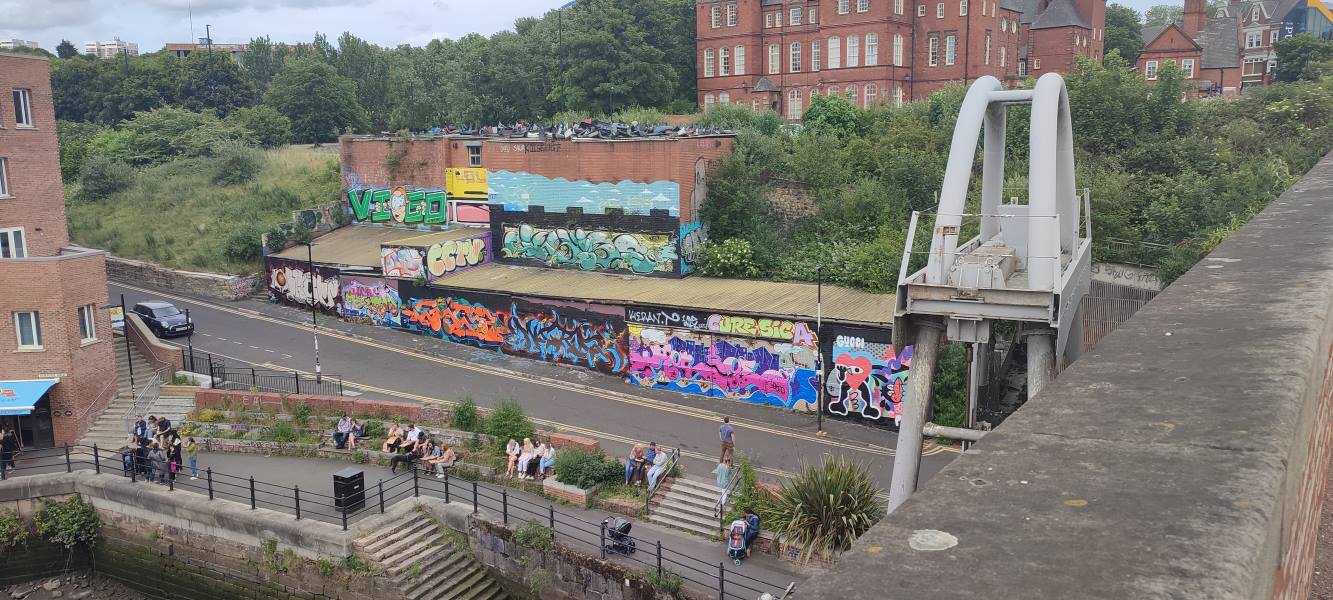
Walls upon walls absolutely covered with artisan graffiti.
Bloody showoffs. (That reminds me — i have a massive unpublished gallery post of a walk down the full length of the Ouseburn, but never did get around to finishing it… maybe soon?)
Your author’s hand holds a nice ice cream.
The most important meal of the day.1
A ticket to see “Top Gun: Maverick” at the Tyneside Cinema.
I’ve decided to join the Sea Org and give my life’s savings to the military-industrial complex. (In all seriousness, it was a bloody brilliant film — everything a blockbuster should be!)

Dispatches from a coastal walk

I had some time to kill after buying my mam a present from Tynemouth’s station market and decided to spend it by taking a walk in the golden hours of the day, now that spring is coming around and the weather isn’t quite so permanently miserable. I thought i might show you some photos.

These are not the warm, jade waters of the Mediterranean — the North Sea is (usually) grim, cold, and trying to kill you.
St Mary’s Lighthouse, off the coast between Seaton Sluice and Whitley Bay. Fond memories of many a school trip.
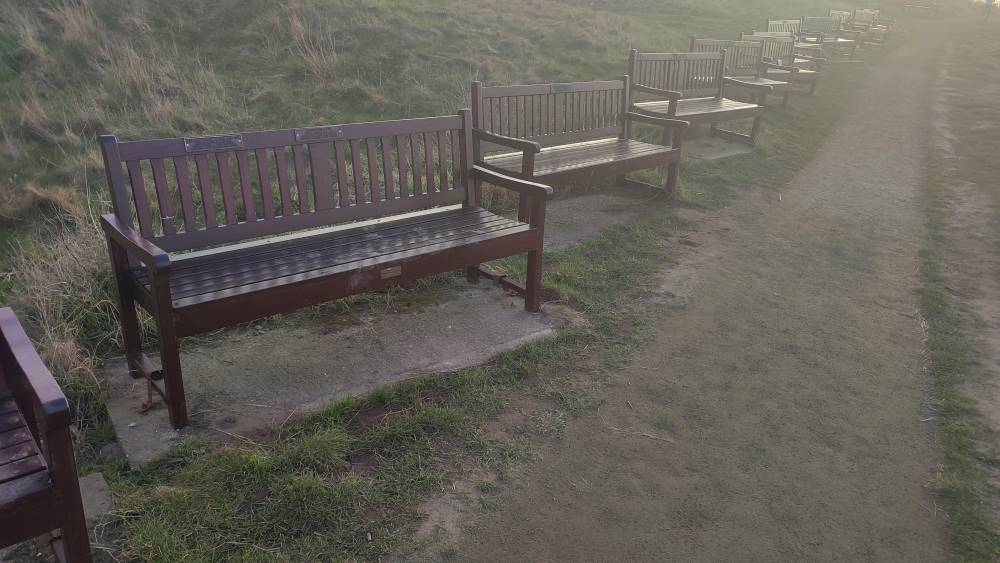
A very long series of public benches
Oh shit i took both pills and now i’m stuck in the Bench Dimension

Chvrches at City Hall

I swear this is fair dealing.

I went to see everyone’s favourite synth-pop act Chvrches a few nights back, and i must say they put on a hell of a show. Even at the City Hall — quite a stuffy venue by most standards — the crowd went absolutely mental for “Clearest Blue” at the end! (I barely know what came over me.)

Great staging, too — i counted three costume changes throughout the night, including a delectably bloody “FINAL GIRL” shirt for the encore. (Their latest album has a horror-movie gimmick crafted entirely to let them swap remixes1 with John Carpenter — not that i’m complaining.)

Now imagine the same distorted whingeing and generic melody for half an hour straight.

The opening act were an Ozzie band called HighSchool who, being brutally honest, should go back to PrimarySchool. They’re one of those acts that basically only know how to write one song over and over, and it’s alright at first, but by take number five of the same sludge you’re praying for it to end, you know? (See also the inexplicably successful 1975 cover band Pale Waves.)

9/10, would stand in line for several hours again.

Eulogy for a food court

I was on my usual city constitutional the other week when i noticed that my favourite bubble tea place1 had shuttered. Hm, that’s odd, i thought. Last time that happened was lockdown. Don’t know why they’d do it again. I assumed they’d be back again swiftly, and went on with my day.

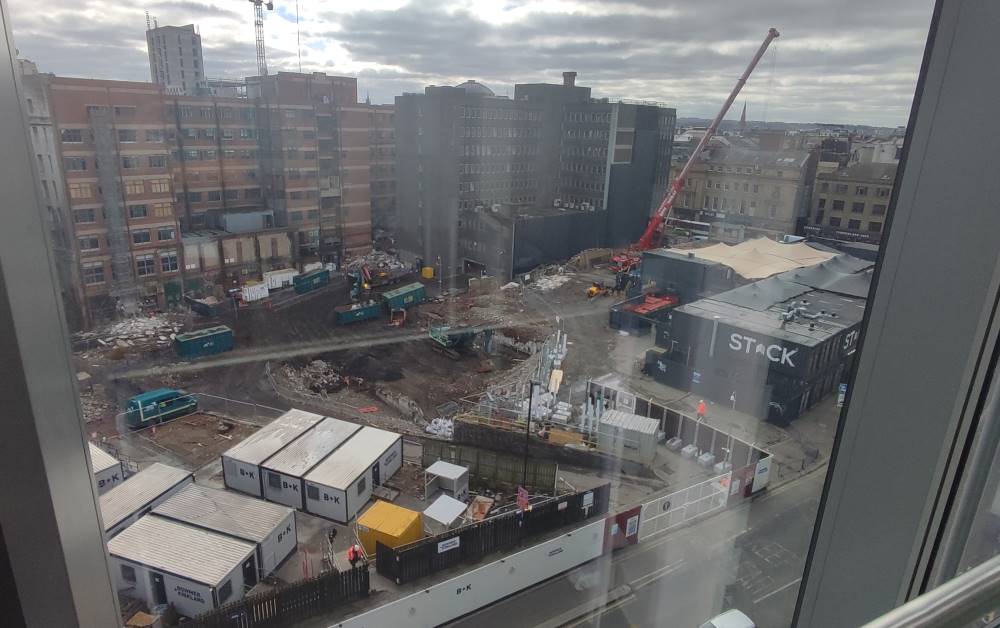
Then the week after i noticed that the entrance to the über-hip shipping-container food court of which it was a part was blocked off. Hm, that’s odd, i thought. Ah, well. It’s probably just construction. These things happen all the time.

It was only yesterday that i saw the crane lifting one of the shipping containers away and realised something (other than the container) was up. Sure enough, one quick google reveals the flashy new development that’ll be taking its place — originally it was going to be mixed-use, but covid crunch caused them to scale back to the thing that covid really, conclusively proved was absolutely 100% necessary and in demand, definitely: offices.

“Pilgrim’s Quarter” is part of a broader redevelopment of the neglected Pilgrim Street, which may or may not include a pedestrianisation — i don’t know; it’s all in jargonese and i can’t make heads or tails of what Enhancing The Public Realm is meant to mean. (Or, for that matter, why they’ve misspelt it as “Pilgrim’s Quater” on the official brochure.)

The permission slips are all in place — so here’s to you, Stack. You might have had some exorbitant prices (sorry, Korean place, but i’m not paying £12 for a few chicken wings and fries), but otherwyze you were a shining beacon of small businesses in the city centre — you were too good for this world. *Pops open a bottle of champagne*

The mystery of Newcastle’s vampire rabbit

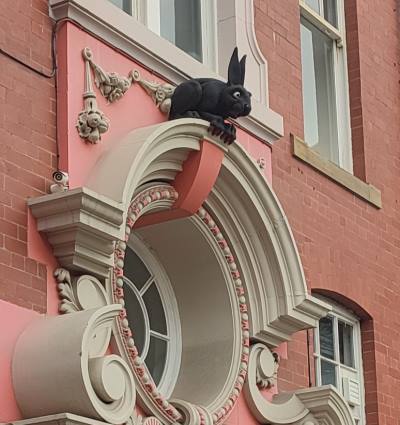
Down a narrow alleyway to the back end of St Nicholas’ Cathedral, in Newcastle, one can find a rather curious decoration garnishing a door on the opposing façade. The “vampire rabbit” has stood watch over the cathedral for at least half a century; while records are scarce (a quick search of Google Books doesn’t bring up anything until the twenty-first century), it could well date back to the building’s construction in 1901.

Spooky.
Here’s a noticeably brighter bun, as it looked in 1987.

Here’s the thing, though. Nobody knows how it got there. Indeed, even the name “vampire rabbit” is a misnomer; its jet-black fur and red claws were added on some time in the 1990s,i as were its distinctly batty ears. Some say it was put there to scare away wannabe graverobbers, but i have my doubts that twentieth-century crooks would be so dumb.

Yet others posit that it represents a mad March hare, arising at the time of Easter, or that it refers to Thomas Bewick, a nearby engraver who had a fondness of all things lagomorphic. Most fascinatingly, a theory advanced by one Mr Adam Curtis suggests a Masonic pun in reference to one George Hare Phillipson, a local doctor (hence vampires) and active Freemason, as was the lead architect, one William H. Wood. It being a secret society in-joke would also explain why it’s located around the back, rather than the front, which faces onto one of the busiest streets in town.

Perhaps we might never know for sure. In any case, it’s a fascinating little secret — what do you think is most likely?

Other people's posts

The Victoria Tunnel

The Victoria Tunnel runs beneath the streets of Newcastle, from the Tyne up to the Town Moor. It traverses not only space, but time, through nearly every corner of England’s history: built to transport coal in the Industrial Revolution, on the site of an old Roman spring, it was used during the second world war to house those fleeing German bombs. It was even considered for use in the cold war, before the government realised that some musty old coal tunnels would probably not provide the greatest protection against a nuclear blast.

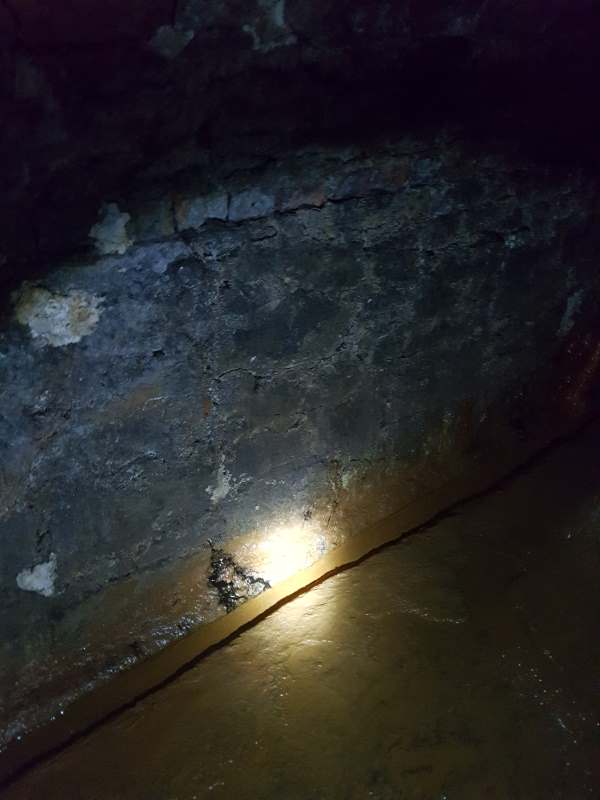
And now you can go down it. In 2007, Newcastle City Council decided to refurbish the tunnel and open a small stretch of it — the rest is either unsafe for sending humans down or currently in use as a sewer — up for public tours. Entry is via a side street along the Ouseburn, where the guides will cheerfully show you a map and some old photographs of the entrance. Once you get inside the tunnel itself, hard hats and torches are compulsory, and covid restrictions are still in full force. This was both a benefit and a malefit: yes, the tour was shorter than it would otherwise be, and masks get quite uncomfortable when you’re wearing them for an hour in a dank, dark tunnel, but on the other hand, our small group of family and friends got the place practically all to ourselves, without having to be shepherded alongside other members of the public.

The water from the ancient Roman spring is directed through a side channel, to avoid it getting all over the tunnel floor. Sometimes it even works!

The tunnel is just barely wide enough to fit three people side-by-side, and if, like me, you’re of a certain height, bumping your head on the roof is practically guaranteed. By every blast door, there’s a plaque about what’s above you, and how it factors into the tunnel and the city’s history, stories with which the guides will gladly regale visitors (including some rather grim tragedies).

Coming back out the entrance, i felt more informed about this wonderful county’s industrial history — just in time to pop over to a gentrified vegan “superfood pub”. The wonders of modern life.

Information for prospective visitors

  • Tours can be booked on the Ouseburn Trust’s website.
  • Price: ÂŁ9–11 per adult depending on the length of the tour; ÂŁ4 per child
  • Address:
    Victoria Tunnel Entrance, Ouse St., Valley, Newcastle upon Tyne NE1 2PF
    — just next to the CrossFit gym.
  • Accessibility: The tunnel was built in the 19th century and without accessibility in mind, so is not wheelchair-accessible. The Ouseburn Trust do, due to the pandemic, offer a virtual tour.
  • Getting there: The Q3 bus from the centre of town stops nearby; otherwise, getting there poses a bit of a hike, due to its location.

Notities van een wandeling door Newcastle

De verukkelijke vallei van de Tyne heeft geen gebrek aan uitstekende uitzichten, maar het mooist is mijns inziens dat wat gezien wordt door iemand die langs de Side loopt.Îą In de schaduw van het Monument, langs de klassieke zuilen van het Theatre Royal (Koninklijk Theater) en over Grey Street zodra zij Dean Street wordt, en eindelijk rechtsaf naar de Side op de bodem, dan zal de gelukkige reiziger zien dat de gigantische groene boog van de brug over de Tyne boven hem torent, als een kolos.

De Tyne Bridge, een hoge groene boog over de rivier, overeind gehouden door twee kolossale torens van zandsteen en baksteen.
Foto door Alex Liivet. CC BY-2.0.
Een krakkemikkige oude trap leidt naar een gebied dat verborgen is door overgroeid struikgewas.
De rottende houten trap, zoals te zien op Google street view.

Ik weet niet of een foto ooit kan weergeven hoe het is om onder die brug te staan. Maar een van de meest opmerkelijke dingen over dit uitzicht heeft niets te maken met het uitzicht zelf. Stel je voor dat onze reiziger nu langs de kade loopt, totdat hij aan een leeg stuk grond komt, en dan halverwege een stel rottende houten trappen oploopt. Hij zal zich vergapen aan het twĂŠĂŠde mooiste uitzicht van de stad: een prachtige panorama op elke brug tussen de twee oevers van de machtige Tyne.

Zeven bruggen over de Tyne, geflankeerd door de oude gebouwen van Newcastle aan de rechterkant en de moderne regeneratie van Gateshead aan de linkerkant.

We verdienen deze stad niet.


Ik had geen fles water meegenomen, want ik wou aanvankelijk alleen maar naar het stadscentrum en terug: het roekeloze idee om helemaal naar Walls­end te gaan kwam spontaan in me op, al ver van huis. De hele weg gaan zonder fles bleek al snel een slecht idee, dus ik klom naar de lokale buurtwinkel — en, godenzijdank, zij hadden al het flessenwater dat iemand ooit zou willen!

Helemaal gehydrateerd, ik was klaar om verder te lopen… maar toen zag ik een wonderbaarlijke ding. Een klein parkje, een opening van groen met een paar banken en inscripties op de grond, verscholen tussen een woonwijk en een bouwplaats. Ik nam enkele foto’s. Ik zou ze graag laten zien, maar helaas, tussen dese reis en het schrijven van deze post werd mijn gsm gestolen.

Als je toch een bezoek wilt brengen, het is dat parkje naast 5 Bel­mont Street. Google weigert me een echt adres te geven, maar je kunt het niet missen!


Een kwaadaardig uitziend kantoorgebouw naast een gigantische witte kubus met het logo "TechnipFMC".

Een verslag van mijn denk­proces wanner ik het boven­staan­de gebouw zag:

  • Dat gebouw ziet er zeer diabolisch uit, maar ik kan niet precies zeggen waarom…
  • Ik ga het bedrijf opzoeken.
  • Ah, een fossiele-energie-bedrijf — ze zijn tĂłch diabolisch!

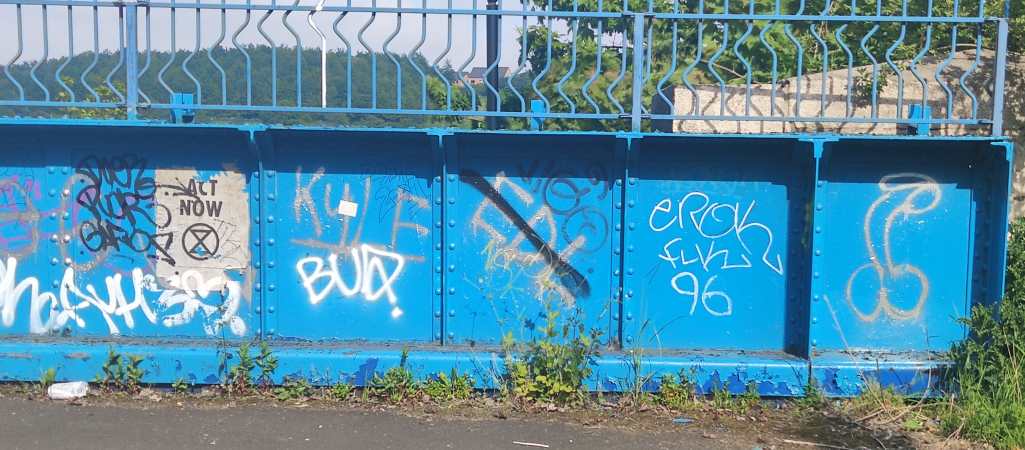
Over een fiets- en voet­gangers­brug dichtbij kwam it wat graffiti tegen die echt de moderne Engelse psyche samenvatten: een poster van Extinction Rebellion", een doorgestreept „EDL”,β en een pik en kloten.

Graffiti op een blauwe brugmuur. Van links naar rechts: Een XR poster met 'Act Now', 'Kyle', 'EDL' (doorgestreept), 'Erok', 'FLK', en een lul en kloten.

Ik droeg een plaat van HMV (Hot Fuss, door de Killers, als je het zo nodig moet weten) de hele weg mee, en laat me je vertellen, mijn armen deden aan het eind ervan echt pijn! Tenminste kwam zij een tas…


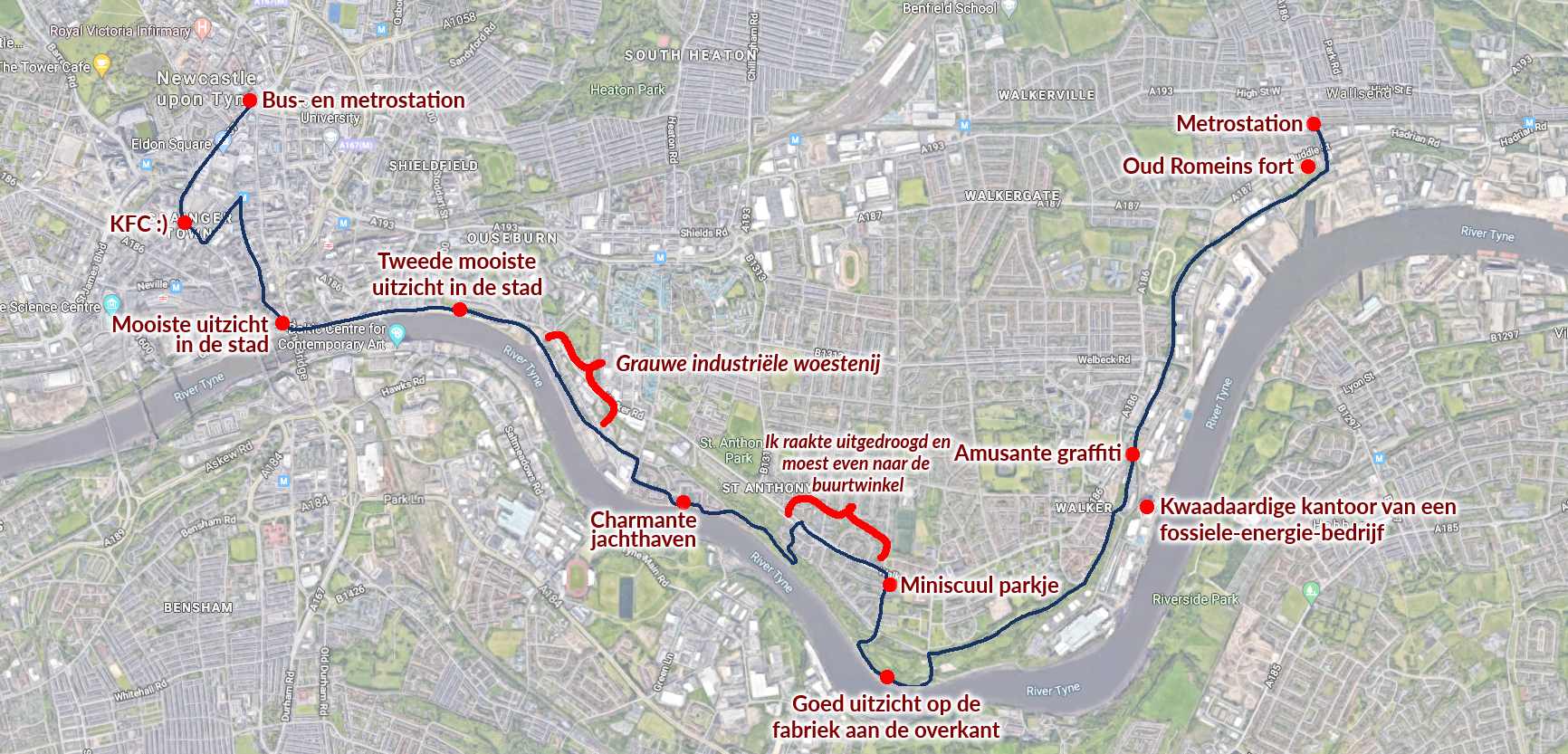
Om af te sluiten, hier zijn vier foto’s die niet interessant genoeg waren voor een volledige sectie, en een kaart van mijn tocht. Bedankt voor het lezen!

Notes from a walk through Newcastle

The gorgeous gorge that is the Tyne valley has no shortage of winsome views, but the most beautiful, in my opinion, is that which appears to one who goes down the Side.α In the Monument’s shadow, after passing the classical columns of the Theatre Royal and descending Grey Street as it becomes Dean Street, finally taking a turn onto the Side at the bottom, the lucky traveller will find themself towered over by the behemoth that is the Tyne Bridge:

The Tyne Bridge, a soaring green arch over the river, held up by two hulking sandstone-brick towers.
Photo by Alex Liivet. Licenced under CC BY-2.0.
A rickety old set of stairs leads into an area obscured by overgrown shrubbery.
The rotting wooden stairs, as seen on Google street view.

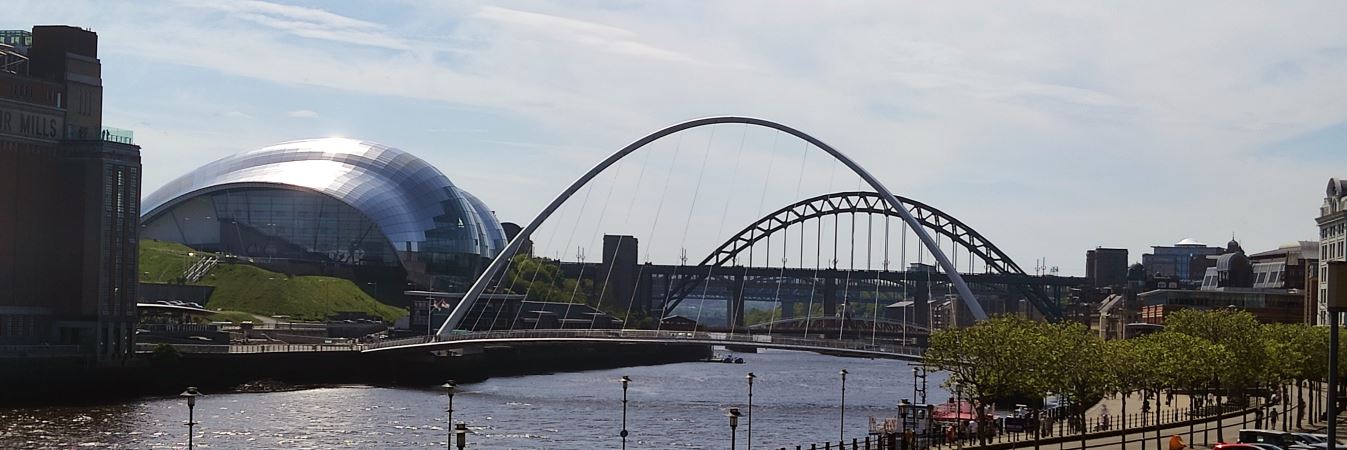
I’m not sure any photograph can ever match what it’s like to be there under that bridge. One of the most remarkable things about this view, though, has nothing to do with the view itself, but rather what happens if one walks down the Quayside for a little while, reaches an empty brownfield plot, and clambers up a set of rotting wooden stairs to its right. Because, inexplicably, just a few metres from the most beautiful view in town, one can find the second most beautiful view in town, a glorious lookout on every bridge linking the two banks of the river.

Seven bridges across the Tyne, flanked by Newcastle’s old buildings on the right and Gateshead’s modern regeneration on the left.

We don’t deserve this city.


I had initially neglected to bring a water bottle along with me; i had only intended a quick jaunt to the centre of town and back, and the foolhardy idea of walking all the way to Wallsend came to me spontaneously. This quickly proved a bad idea, and so i made a trek up to the corner shop, who thankfully had all the bottled water anyone could ever want or need.

After leaving fully rehydrated and ready to walk back, i noticed the most wonderful little thing. A parklet, this small opening of green space with some benches and inscriptions, tucked between a housing area and a construction site. I took some pictures — i would have loved to show them to you, but alas, my phone got stolen in the intervening time between this trip and me writing this post, taking the photographs with it.

Nevertheless, if you’d like to visit (or live vicariously through Google street view), it’s that little park adjacent to 5 Belmont Street. (Google stubbornly refuses to give a proper address, but you can’t miss it!)


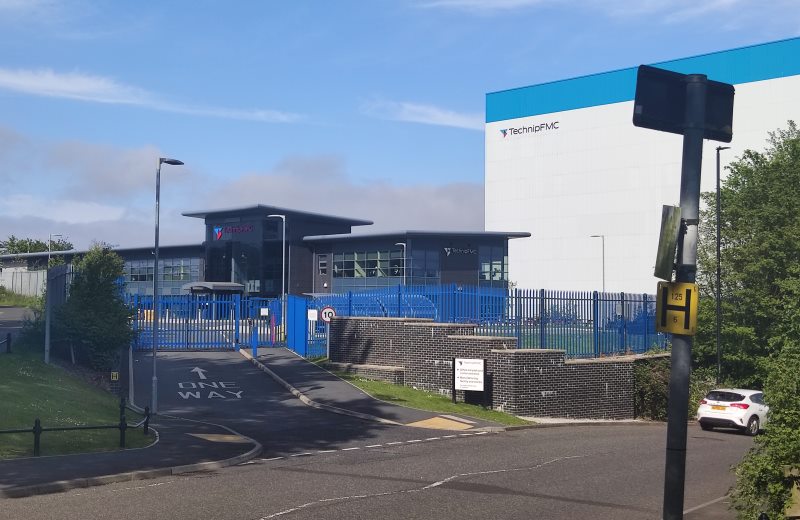
An *exceedingly* evil looking office building next to a gigantic white cube bearing the logo "TechnipFMC".

An account of my thought process upon seeing the above building complex:

  • That building looks exceedingly evil, but i can’t quite place my finger on why…
  • I’m going to look the company up.
  • Ah, a fossil fuel company — they are evil!

Just a few yards ahead, crossing a foot-and-cycle bridge, i happened upon some strikingly relevant graffiti, alongside some other pieces which really sum up the modern English psyche: an Extinction Rebellion poster, a crossed out “EDL”,β and a cock and bollocks.

Graffiti on a blue bridge wall. Left to right: An XR poster saying 'Act Now', 'Kyle', 'EDL' (crossed out), 'Erok', 'FLK', and a cock and bollocks.

I carried a record from HMV (the Killers’ Hot Fuss, if you must know) the whole way, and let me tell you, my arms were positively aching by the end of it! At least i had a bag…γ


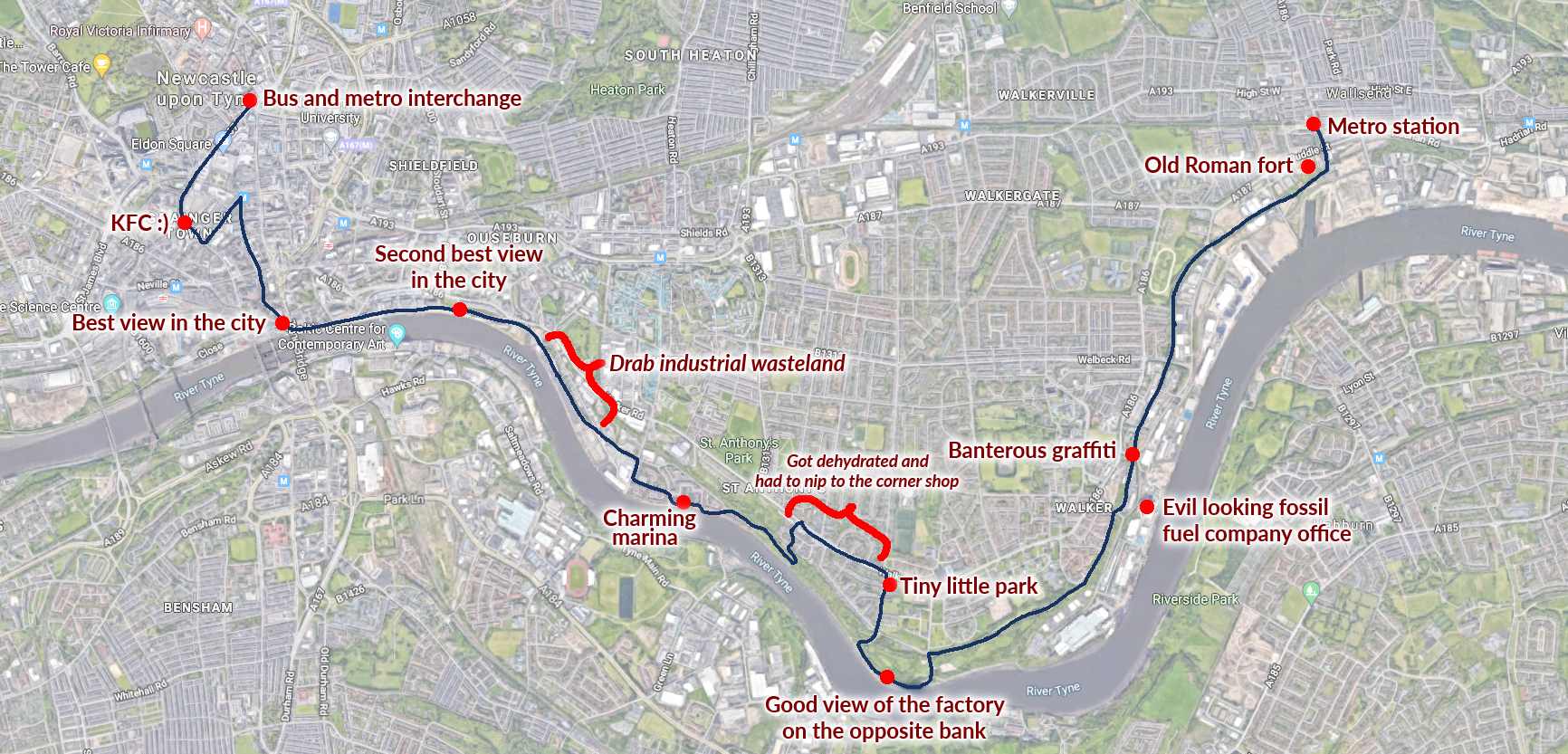
To sign off, here are some photos whose stories weren’t interesting enough to make the cut, as well as a map of the journey. Thank you for reading this disjoint mess.